


How to Use a Simple Form to Engage and Understand Language Performance
I recently had the opportunity to collaborate with administrators across my school district by supporting their analysis of English learner and immersion student data within our MTSS framework. In our district, we include English learners in our MTSS procedures and framework. We monitor their progress, review, and discuss performance during each data cycle.
As part of this collaboration, I shared an MTSS data collection form. We use this form to capture and discuss students’ educational backgrounds and language development. During the presentation, I introduced an Excel-based Dashboard that our Supervisor of Assessment created for us. The dashboard displays students’ most recent language scores across the four language domains: listening, speaking, reading, and writing. The spreadsheet averages performance by grade level and domain, allowing administrators to quickly identify strengths and areas for growth.
The Excel tool is a great resource to use with the WIDA’s school frequency report, which summarizes grade-level performance. However, our district’s performance dashboard extends this functionality by allowing administrators to compare grade-level performance across multiple schools. This interactive feature encourages deeper analysis and more meaningful conversations about instructional supports within and across sites.
Using a Language Performance Review Form
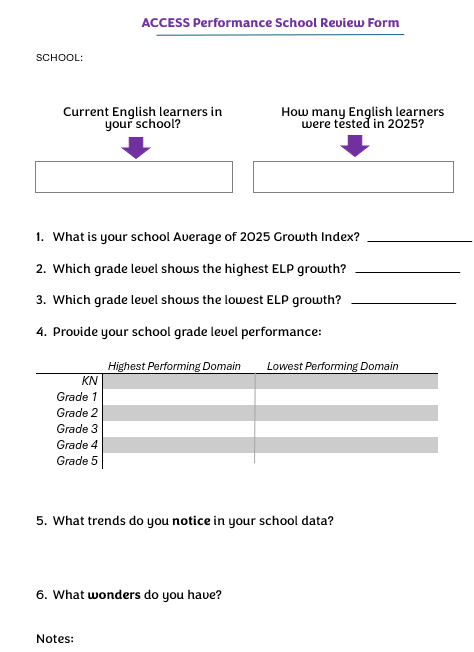
To support administrators in navigating the dashboard during their initial review, I created a Language Performance School Review Form. The form was intentionally designed as a “scavenger hunt” to guide administrators through the data and promote active engagement rather than passive review. The form includes six guiding questions:
- Administrators identify their school’s average 2025 Growth Index, grounding the analysis in overall language growth.
- They determine which grade level shows the highest ELP growth, helping to surface effective instructional practices.
- They identify which grade level shows the lowest ELP growth, highlighting areas that may need additional MTSS support.
- Administrators review grade-level performance by language domain (listening, speaking, reading, and writing), noting the highest- and lowest-performing domains for each grade level.
- They reflect on trends observed in their school’s data, such as patterns across grade levels or domains.
- Finally, administrators record wonders or questions that emerge from the data, encouraging inquiry and follow-up discussion during MTSS meetings.
Download a copy of the Language Performance Form for FREE ===>
Join my NEW document sharing hub!
Download the Language Performance Form here to get an editable Google document you can use in Elementary, Middle, or High School.
Join once to access current and future resources we’ll share with each other as a community.
Next Steps Using Language Performance Form
Following the initial data review, administrators can bring these findings to grade-level team meetings. The form can help facilitate collaborative discussions around student performance. Using the identified strengths and areas of need by language domain, teams can plan targeted instructional supports and interventions aligned to MTSS. This may include adjusting instructional strategies, integrating specific language objectives, or prioritizing certain domains (e.g., speaking or writing) for focused instruction. These next steps ensure that language data is not only reviewed but also actively informs instruction and supports English learners’ continued language growth.
Join my NEW document sharing hub!
Download the Language Performance Form here to get an editable Google document you can use in Elementary, Middle, or High School.
Join once to access current and future resources we’ll share with each other as a community.