

How to Avoid School-Related Translation Inaccuracies
Educators understand the vital importance of communicating with families in multiple languages. Clear communication builds trust, ensures families are informed, and supports student success. Yet, many don’t realize the risks and potential harm caused by relying on online translation tools. While convenient, these tools can confuse families or even convey incorrect or misleading information.
Interpreting vs. Translating: Knowing the Difference
It’s important to understand the distinction between interpreting and translating:
- Interpreting: Oral communication, where interpreters convey information spoken in one language into another.
- Translating: Written communication, where translators provide documents or messages in a family’s home language.
Both roles are essential, but they are not interchangeable. Misunderstandings about this difference often lead to inappropriate reliance on tools or staff who are not trained for the task.
Why Translation Matters
Written translation is not just a courtesy—it is a bridge to equitable access. For example, when a field trip form is translated into Spanish, families who don’t speak English can:
- Fully understand the details of the trip.
- Respond quickly and accurately.
- Provide schools with the necessary permission and information.
In this way, translation helps schools operate smoothly while ensuring families are empowered to support their children’s education.
Legal and Civil Rights Requirements
Schools are legally obligated to provide language assistance. The Office for Civil Rights (OCR) requires schools to communicate with limited English proficient (LEP) families in a language they can understand. Importantly, this obligation applies even if the student is proficient in English.
Failure to meet these requirements may result not only in family disengagement but also in civil rights violations.
The Problem with Online Translation Tools
Online translation tools like Google Translate can seem appealing because they are:
- Free
- Fast
- Available in many languages
However, these tools often produce inaccurate, misleading, or culturally inappropriate translations.
Example of Risk
A recent school survey highlighted this risk:
The English version asked: “How many students will be enrolled in the school this year?”
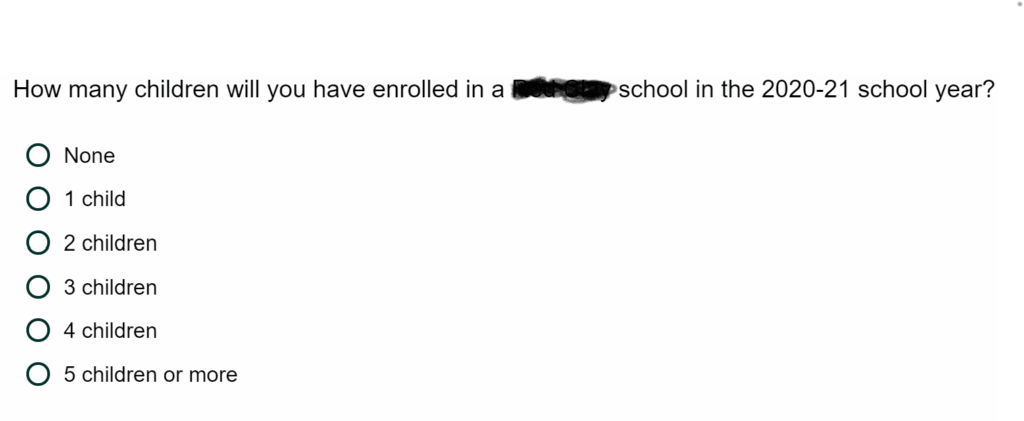
while, the Spanish translation shown on the right, asks “how many students will you enroll in the school during the 2020-21 school year?”
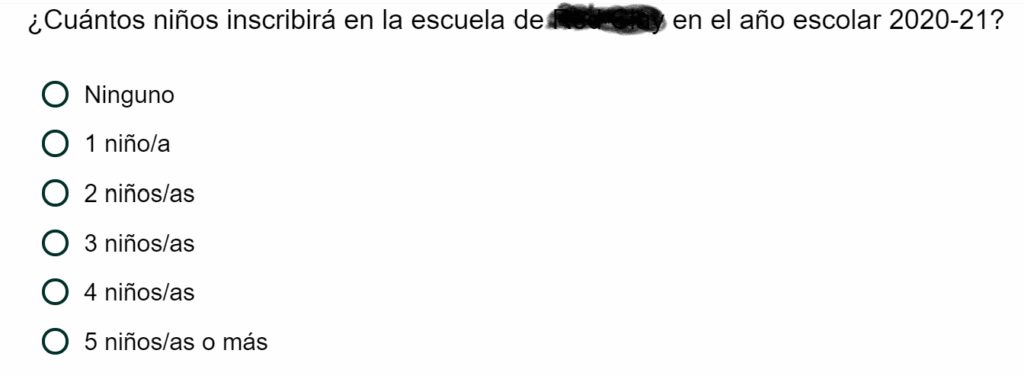
This mistranslation changed the meaning entirely. A parent responded “ninguno” (“none”), which caused the system to assume they had no children enrolled. The survey ended, excluding their input.
Such errors are not minor—they can distort data, confuse families, and damage trust.
How Schools Can Avoid Inaccuracies
To minimize the risks of mistranslation, schools should:
- void using online tools for official documents.
Quick translations may be acceptable for informal or one-time communications, but never for official forms, letters, or policies. - Review translations carefully.
If a translation tool must be used, ensure the document is re-read and reviewed by someone fluent in the target language for accuracy, flow, and readability. - Be transparent.
If an online tool was used, consider adding a note explaining this to families. This helps them understand that errors are possible. - Use professional services.
When possible, work with professional translators or contracted services for accuracy. For verbal clarification, consider using over-the-phone interpreters to walk families through the information.
Building Trust Through Accurate Communication
School-family relationships thrive when communication is clear, accurate, and respectful of families’ languages. While online translation tools may feel like a quick solution, they can create bigger problems if used improperly.
By investing in accurate translation and interpretation practices, schools not only meet legal requirements but also strengthen family engagement and support the success of every student.
👉 Key Takeaway: Online translation tools are helpful in limited, informal contexts but should never replace professional translation or interpretation for official communication. Schools must prioritize accuracy to protect families, students, and the trust that underpins effective partnerships.