


As parents, we sometimes pause our education by solely dedicating our time and effort to furthering our children’s education. Did I say pause!? Yes! We often choose not to continue our education and forget that furthering our careers and education benefits our kids.
Getting an education is too often put aside and not a priority. I am here to tell you why getting an education can benefit everyone and serve as an example to others.
Consider your education status
Figuring out what to do to further your education can seem like a huge task. However, setting career goals is the first step to deciding how to proceed. Once you decide to return to school, you’ll want to determine your education level. In most countries, you’ll see that education follows a trajectory that may look like this:
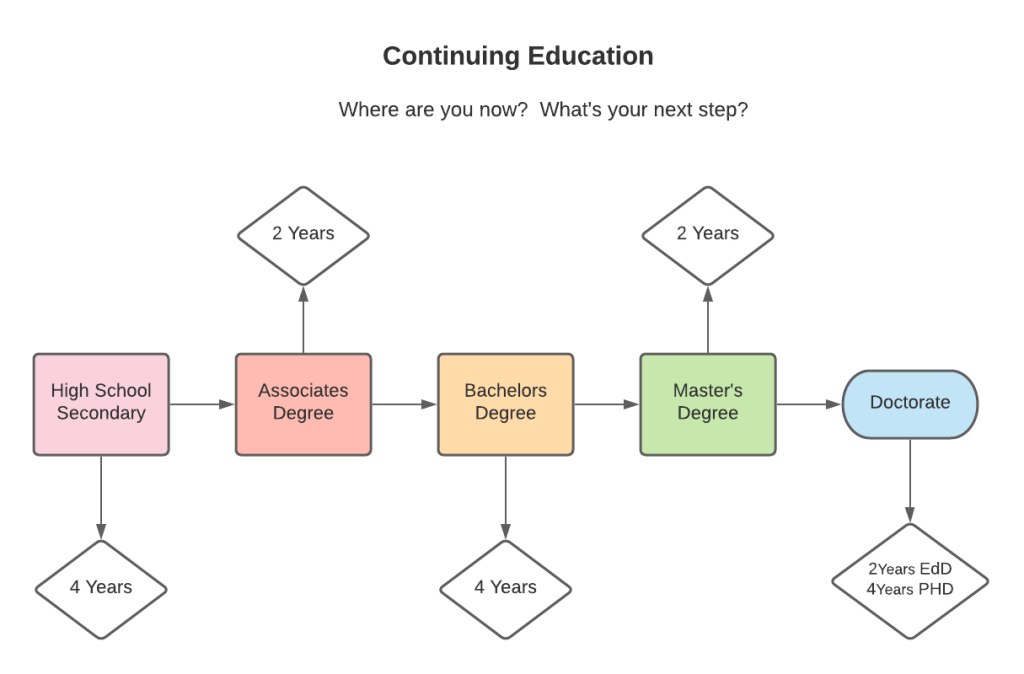
Most college degrees take at least two years to complete. If you have completed a high school diploma, you might want to consider starting an associate’s or bachelor’s degree program. Remember that associate’s and bachelor’s degrees are the only two degrees you might be able to interchange. Some community colleges offer associate’s only degrees, hence why they are called community colleges. Larger universities offer bachelor’s and master’s degrees.
Determine a career you want to pursue
Once you determine your educational level, you’ll want to determine your career interests. Think about what you enjoy doing the most. Are you attracted to health, education, social work, technology, or marketing? There are unlimited professions offered across colleges and universities. Your career interest influences the college or university you will want to pursue.
For example, if you enjoy medical work, you may want to look into nursing, medical assistance, physical therapy, or radiology. Selecting an area you are interested in is key to getting to the finish line!
What to do if you have a High School Diploma
A high school diploma will automatically allow you to register for a community college within your area. Many community colleges have open enrollment for students who graduate from high school. Community colleges are two-year schools that provide affordable post secondary education as a pathway to a four-year degree. Some attend community college to obtain an associate’s degree in two years, but may never continue their education. This may be because, for some careers, an associate’s degree may be enough.
College students experience vocational training in a community and obtain certificates, diplomas, or an associate’s degree. Diplomas and education certificate programs may last weeks or several months. Students who may want to learn a particular skill are candidates for certificates or diplomas.
Some popular programs you’ll find in a community college are nursing, law enforcement, and web technology. However, some medical programs may have additional requirements for entry. Did you know that in the fall of 2012, 12.8 million students were enrolled in community colleges?
Applying for Community College
An application is part of the entry requirement to attend a community college. Most community colleges have an online application process that requires basic information and proof of a high school transcript or GED. Additionally, there is an application fee that varies depending on the institution.
Associate degrees come with textbooks and tuition fees. Some community colleges offer scholarships to local high school graduates. Financial aid is also available to families that may qualify based on their income.
To apply to a community college, you’ll want to schedule an appointment with a college counselor or complete the online application. If you choose to complete the online application, the school will follow up with an email and eventually schedule you to come in person. An advisor will provide you with program information and course options. Come ready to ask questions and inquire about financial aid and scholarships.
Why continue education in a Community college?
- Improve GPA to pursue a Bachelor’s degree
- transfer into a four-year college (save money)
- convenient location
- obtain enough credits to become a police officer
- complete a trait or training in a specific area
What if you have an Associate’s Degree?
If you already have an associate’s degree, the next level of education to pursue is a Bachelor’s degree. Four-year universities offer a wide variety of educational focuses. A university is an institution of higher education and research that awards academic degrees in various academic disciplines.
According to Wikipedia, Universities typically offer both undergraduate and postgraduate programs. In the United States, universities must offer graduate degrees; institutions offering only undergraduate degrees are colleges. Some popular programs are Business administration, liberal arts, registered nursing, psychology, technology, and many more.
Consider whether you’d like to expand your associate’s degree education into a Bachelor’s degree to continue your education. An advisor can review your associate’s degree courses to determine which classes can transfer into a Bachelor’s program and which classes may not. You’ll want to know this information before enrolling in a 4-year university.
The number of classes a university accepts influences the courses you’ll need to take to obtain a Bachelor’s degree. The more classes, the higher the number of credits you’ll have to pursue a Bachelor’s degree.
How to apply
To apply to a 4-year university, you’ll need to review the university’s admission policy on its website. All universities have an admissions office that you can call and visit to inquire about their application process. A 4-year university will most likely have more requirements than a 2-year college. Most universities require a minimum of 2.5 GPA, recommendation letters, a written essay, and entrance exams.
Master’s Degree
If you have a Bachelor’s degree, the next level of education to pursue is a Master’s degree. A Master’s degree takes two years to complete. A master’s degree is an academic degree awarded by universities or colleges upon completion of a course of study demonstrating mastery or a high-order overview of a specific field of study or area of professional practice.
Completing a Master’s degree makes someone a specialist in a certain area. For example, the most common areas that require a master’s degree are education, business management, computer science, psychology, and counseling.
Most people pursuing a master’s degree aim to move up in their current position or sometimes may want to change careers. A person with a Business administration degree may experience a change of heart and sometimes switch to teaching. Completing a master’s degree is a new start and does not require any transfer of credits.
How to apply
You’ll need to review the university’s admission policy on the website to apply for graduate school. All graduate programs have an admissions office that you can call and visit to inquire about their application process. Most universities require a minimum of a 3.0 GPA, recommendation letters, a written essay, and entrance exams. However, please remember that these requirements vary depending on the education programs.
Funding options to continue education
There aren’t many scholarships available to fund Master’s degrees. However, scholarships are readily available to fund bachelor’s degrees. Some jobs provide tuition reimbursement to fund related classes with certain stipulations. Graduate-level courses are much higher than undergraduate courses. For instance, a graduate-level credit can cost twice as much as undergraduate credit. Consider your funding options as you review academic programs and educational institutions.
I hope this information has given you an idea of what to do next to continue and pursue higher education. It is never too late to obtain an education and reach higher career goals. Remember that our desire to educate ourselves will show our kids the importance of obtaining an education.
I totally agree with you when you said to pursue what you enjoy doing the most. My brother just got out of rehab and he was looking for continuing education to restart his life. I’m going to recommend him to pursue a career in architecture because designing houses was his passion back then. Now it’s just all about finding the right continued education institution that will perfectly fit him.
I agree. And it’s never late to start. When we do what we enjoy the most it doesn’t feel like a job.
Thank you for Sharing these information. Valley Oak Junior College: Nurturing Tomorrow’s Leaders in Hyderabad. Thank You for Sharing these information also click here to get more infomation realtes you
Link : https://valleyoak.in/